MILA: what minimally invasive lipoabdominoplasty is
MILA stands for Minimally Invasive LipoAbdominoplasty. Is it a new technique? No, it is a surgical tactic, systematized in 2024 by Christiano Claus and Ezequiel Palmisano, that brings three well-known steps together in a single operation: liposuction, endoscopic plication of the diastasis in the pre-aponeurotic plane and skin retraction with energy-based devices. The aim is a result close to that of an abdominoplasty without the long scar of the classic operation, in selected patients with defects of limited size.
What is MILA?
MILA is neither a new route into the abdominal wall nor a new technique: it is a tactic, that is, a way of combining known procedures into a single strategy. To endoscopic plication of the diastasis through the pre-aponeurotic plane — the very procedure that appears in the literature under the names SCOLA, REPA and EPAR — two stages belonging to plastic surgery are added: liposuction and skin retraction with energy-based devices. The rationale stated by the authors confirms something already well known: endoscopic plication alone works well in patients without excess skin and fat, who are a minority; adding the other two stages widens the group of patients who can be treated.
The name puts together the three words that describe the intent: lipo, the removal of fat; abdomino, the repair of the wall; plasty, the reshaping. Minimally invasive, because everything goes through three small suprapubic incisions, laparoscopically or robotically, instead of the transverse scar of an abdominoplasty.
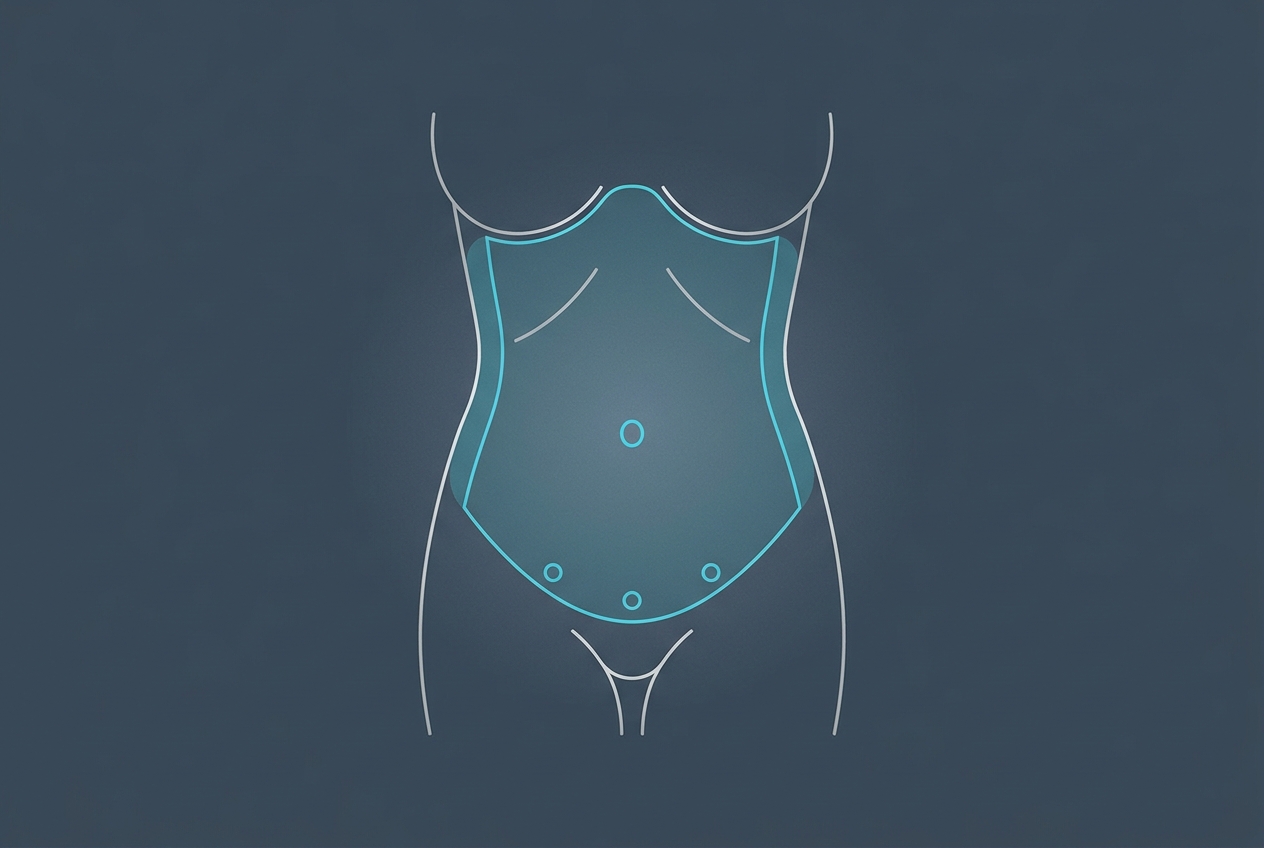
What are the three stages?
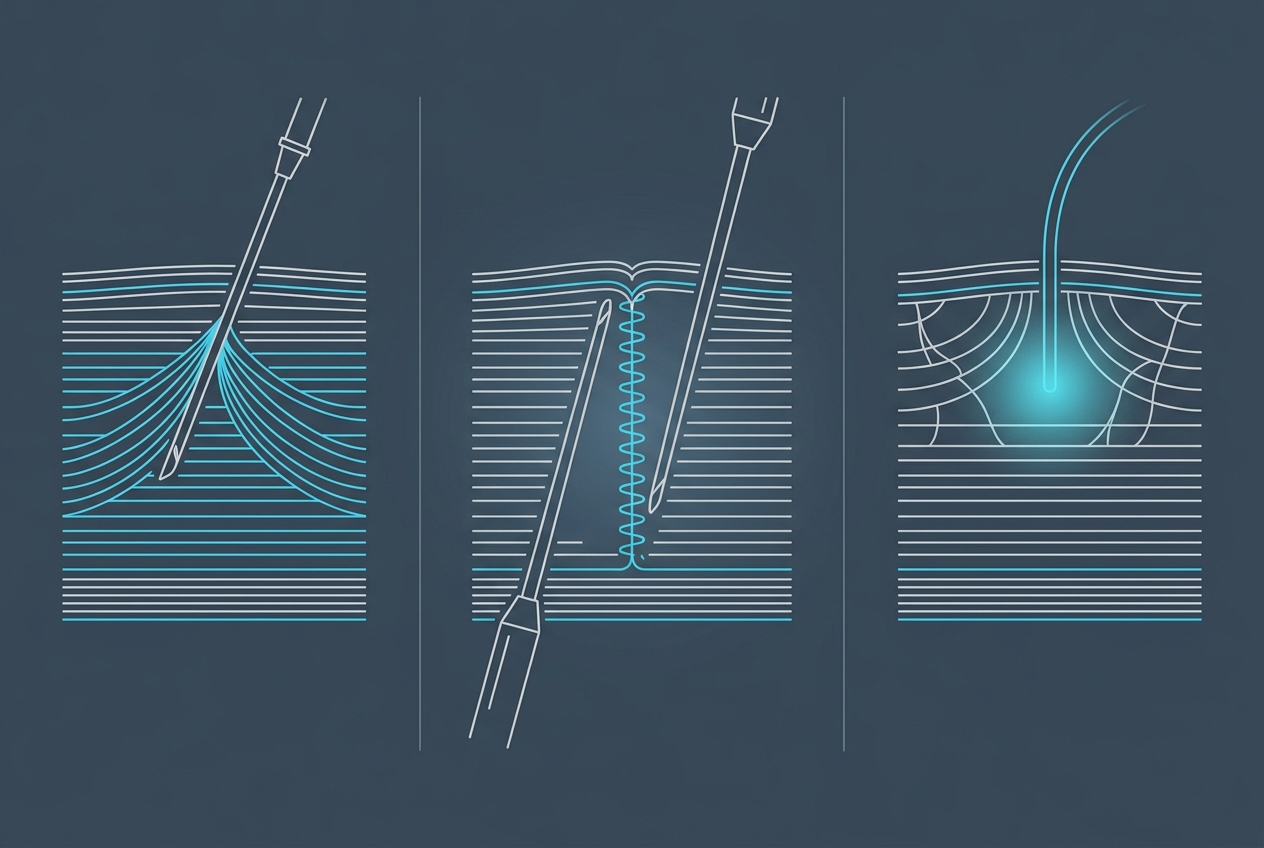
The three stages are consecutive and, according to the authors, synergistic: each one makes the next easier and they all use the same incisions.
- Liposuction. The subcutaneous tissue is infiltrated with saline, lidocaine and adrenaline, the fat is emulsified with ultrasound or laser energy and then aspirated. Aggressive cannulas are to be avoided: the fibro-connective network of the subcutaneous tissue must stay intact, because it is the target of the third stage. When a midline hernia is present, liposuction of the midline is carried out only after the repair, so as not to damage the contents of the sac.
- Endoscopic plication. Through a 2 cm midline suprapubic incision and two lateral 5 mm ports the pre-aponeurotic plane is dissected from the pubis up to the xiphoid and the costal margins, with CO₂ at 6-10 mmHg. The diastasis is plicated with a single continuous barbed suture, from the xiphoid to the pubis. Mesh is optional: it is used when a hernia is present, in the onlay position, overlapping the plication by 3-4 cm on each side.
- Skin retraction. Through the same incisions, energy-based devices are applied — helium plasma radiofrequency, bipolar radiofrequency, 980 nm diode laser — acting on the fibro-connective septa and stimulating collagen remodeling. Over the central area, already dissected, power settings are reduced by 30-40% compared with the flanks, and skin perfusion is checked throughout the stage to avoid burns and damage to the subdermal vascular plexus. One or two suction drains are then placed in the subcutaneous space.
Who described it, and where?
The systematization of the MILA tactic was published in 2024 in the Revista do Colégio Brasileiro de Cirurgiões by Christiano Marlo Paggi Claus with Guillermo Di-Biasio, Raidel Deucher Ribeiro, Marco Aurelio Faria Correa, Bruno Pagnoncelli and Ezequiel Palmisano (Rev Col Bras Cir 2024;51:e20243692). The principle of videoendoscopic subcutaneous surgery is far older, though: it goes back to Marco Faria Correa, who described it in Plastic and Reconstructive Surgery in 1995. A technical update published in 2026 in the same Brazilian journal proposes preserving the umbilical ligament in patients without an associated umbilical hernia, so as not to alter the anatomy and the natural contour of the umbilicus.
Which patients is it for?
It is an intermediate procedure, between open surgery and simple minimally invasive repair, whose aim is to improve the morphological outcome by promoting skin retraction while avoiding the incision typical of an abdominoplasty. The indication is clearly a diastasis of moderate size, a small umbilical hernia and a moderate excess of skin, such that thermal redraping can treat it with a favorable outcome. For a significant excess of skin, nothing today matches the open approach in terms of the quality of the morphological result.
When is it not the right choice?
MILA shares the limits of every pre-aponeurotic technique and adds some of its own. It is not the right answer when:
- the excess of skin is real and significant, and not simple laxity: no retraction technology replaces a resection, and in these cases mini-abdominoplasty or abdominoplasty remain the correct operations;
- the patient has a high body mass index, severely compromised skin or previous complex midline surgery.
How do MILA, SCOLA, REPA and TESAR differ?
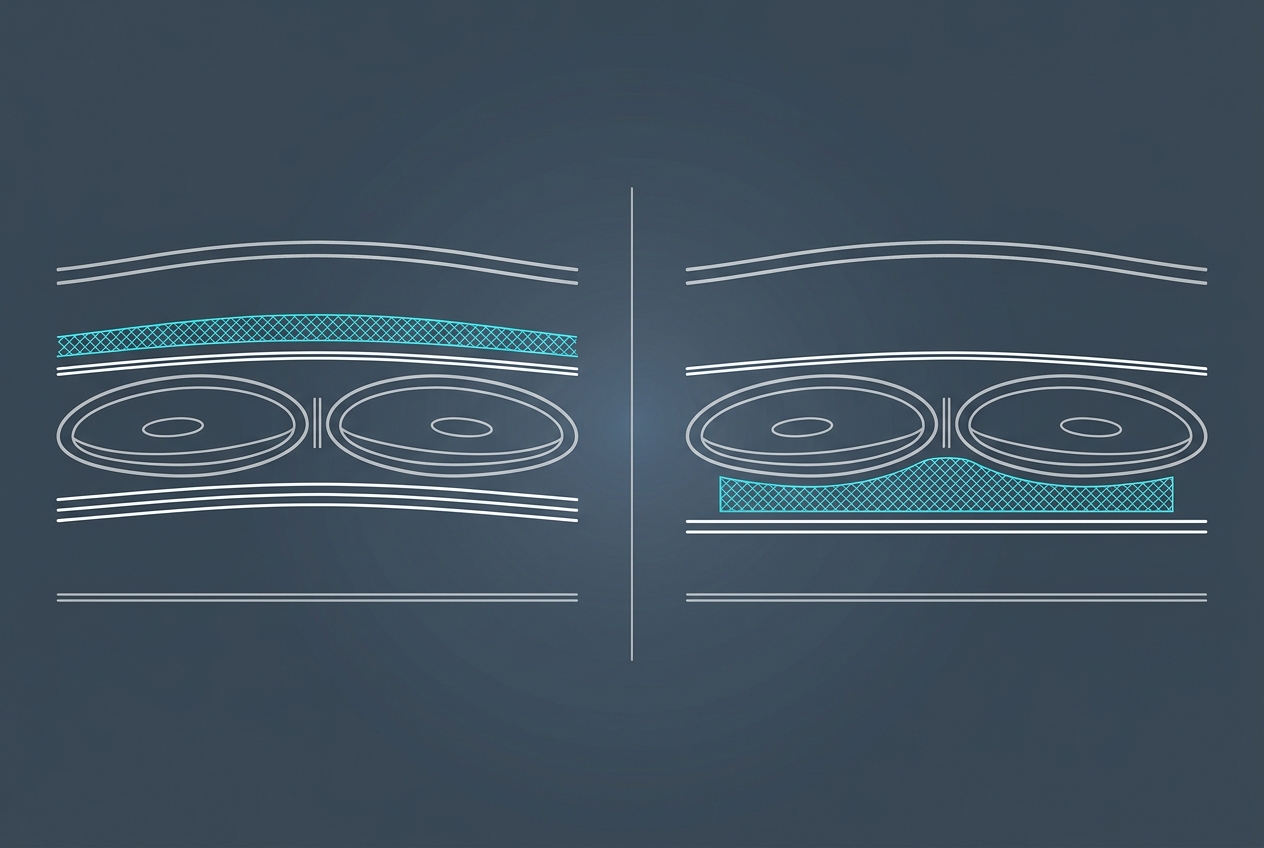
SCOLA, REPA and EPAR are different names for the same family of procedures: anterior access, work in the pre-aponeurotic plane, midline plication, onlay mesh where needed. TESAR belongs to another family. The access is anterior, but the final working plane is retromuscular: the medial edges of the rectus sheaths are incised, the space behind the muscle is entered and the mesh is placed sublay, behind the rectus, without ever opening the abdominal cavity. TESAR aims at the structural reconstruction of the midline with a retromuscular mesh, and it is also used in incisional hernias and in previously operated patients. MILA is the morphological extension of minimally invasive approaches: it adds liposuction and skin retraction to the same repair in order to improve the aesthetic outcome.
Glossary of minimally invasive abdominal wall acronyms
Frequently asked questions about MILA
- Does MILA replace abdominoplasty?
- No. MILA is designed for patients who do not have a real excess of skin, or who do not want the transverse scar of an abdominoplasty. When the excess of skin is real, resection remains necessary: no retraction technology replaces it. MILA may take the place of many current indications for mini-abdominoplasty, not of full abdominoplasty.
- Can MILA be performed with the TESAR technique?
- Yes. The devices used for tissue retraction can be employed alongside every surgical technique: the simple plication described in the original publication can be replaced by any minimally invasive repair, including TESAR with a retromuscular mesh. In substance MILA is the combination of three steps: liposuction, minimally invasive repair of the musculo-fascial wall defect and treatment of the soft tissues with thermal remodeling devices.
- Is mesh always used in MILA?
- No. The use of mesh depends on the presence and the size of the associated hernia. In the original description, when it is used, it is a large-pore mesh placed onlay, that is, in front of the fascia, overlapping the plication by 3-4 cm on each side. If the repair is performed with TESAR, the mesh is retromuscular instead.
Last updated: 2026-08-20 · Content by Dr. Federico Fiori